

Table of Contents
How Do I Analyze the Cost Per Lead (CPL) for Different Investor Segments?
In the fast-paced brokerage industry, where attracting the right investors can make or break your growth, mastering Cost Per Lead (CPL) analysis is essential. CPL represents the total advertising spend divided by the number of leads generated, providing a clear metric for marketing efficiency. However, treating all leads the same overlooks the diverse value across investor segments, such as retail investors, high-net-worth individuals (HNIs), accredited investors, and institutional players. For brokerage firms, retail leads might come cheap but convert slowly, while HNI leads cost more yet deliver higher lifetime value. By segmenting CPL analysis, you uncover insights to refine targeting, optimize budgets, and boost ROI. As a Melbourne-based digital marketing firm, PKRank helps brokerage owners like you navigate this process, turning data into actionable strategies that drive qualified leads.
What is Cost Per Lead
Cost Per Lead (CPL) is a fundamental KPI in digital marketing, calculated as the total campaign expenditure divided by the number of leads acquired. For instance, if you spend $10,000 on Google Ads and generate 200 leads, your CPL is $50. This metric goes beyond surface-level costs, revealing the true expense of acquiring potential clients. In brokerage contexts, leads might stem from webinars, social media campaigns, or SEO-optimized content targeting investor pain points like portfolio diversification or market volatility.
Transitioning to segmentation elevates this analysis. Not all investors respond identically to marketing channels; retail investors may favor low-cost Facebook ads, while HNIs prefer LinkedIn premium outreach. Understanding baseline CPL sets the stage for granular breakdowns, ensuring your marketing dollars yield high-value prospects.
Why Segment CPL by Investor Type
Segmentation transforms generic CPL into a strategic tool. Brokerage firms serve varied investor profiles: retail investors seek accessible advice, HNIs demand personalized strategies, accredited investors prioritize exclusive opportunities, and institutions focus on scale. Lumping them together masks inefficiencies—for example, overspending on low-conversion retail channels while underinvesting in lucrative HNI campaigns.
Benefits include precise budget allocation, improved lead quality, and enhanced forecasting. By analyzing CPL per segment, you identify top-performing channels, spot underperformers, and tailor content—such as educational ebooks for retail or whitepapers for institutions. This approach not only lowers overall CPL but also correlates it with conversion rates and client acquisition costs, fostering sustainable growth.
Steps to Analyze CPL for Investor Segments
To conduct a thorough CPL analysis, follow a structured process. This ensures accuracy and reveals optimization opportunities across segments. Begin by defining clear investor categories based on your CRM data, demographics, or behavior, then track and compute metrics systematically.
- Define Investor Segments: Categorize leads using criteria like net worth (e.g., retail under $100K, HNI over $1M), investment size, or source behavior. Integrate tags in your CRM like HubSpot or Salesforce.
- Track Spend and Leads by Segment: Use UTM parameters in ad platforms (Google Ads, LinkedIn) and pixel tracking to attribute costs. Segment leads via forms capturing investor type.
- Calculate CPL per Segment: Divide segment-specific spend by leads generated. Formula: CPL = Ad Spend for Segment / Leads from Segment.
- Benchmark and Compare: Contrast against industry averages (e.g., $20-50 for retail, $200+ for HNI) and internal historical data.
- Analyze Trends and Correlations: Review over time, correlating with conversion rates, lead-to-client ratios, and lifetime value (LTV).
- Optimize and Iterate: Adjust bids, audiences, or creatives based on insights, then retest quarterly.
With these steps in place, you’ll gain a data-driven view, paving the way for tools that streamline the process.
Essential Tools and Metrics
Effective analysis relies on robust tools. Google Analytics and Ads provide attribution data, while platforms like Facebook Ads Manager offer granular breakdowns. CRM integrations (e.g., Pipedrive for brokerages) tag segments automatically. Advanced options include Mixpanel for behavioral insights or Looker for dashboards visualizing CPL variances.
Key metrics to pair with CPL include lead volume, quality score (conversion potential), and cost per acquisition (CPA). For deeper analysis, compute LTV/CPL ratio—aim for 3:1 or higher. These elements interconnect, allowing you to shift budgets fluidly; for example, if HNI CPL rises but LTV justifies it, scale up confidently.
Practical Example of CPL Analysis
To illustrate, consider a brokerage firm’s quarterly campaign data across segments. The table below shows hypothetical results from a $50,000 total spend, highlighting disparities and decisions.
| Investor Segment | Ad Spend ($) | Leads Generated | CPL ($) | Conversion Rate (%) | LTV per Client ($) |
|---|---|---|---|---|---|
| Retail Investors | 15,000 | 500 | 30 | 5 | 2,500 |
| High-Net-Worth (HNI) | 20,000 | 80 | 250 | 25 | 50,000 |
| Accredited Investors | 10,000 | 50 | 200 | 20 | 30,000 |
| Institutional | 5,000 | 10 | 500 | 40 | 200,000 |
Here, retail CPL is low at $30, but HNI and institutional segments shine in LTV despite higher costs, justifying reallocation. Interpretation reveals retail’s volume play versus premium segments’ quality focus, guiding future campaigns.
Best Practices for Ongoing Optimization
Sustained success demands vigilance. Regularly A/B test ad creatives tailored to segments—short videos for retail, case studies for HNIs. Leverage retargeting for warm leads to drop CPL by 20-30%. Monitor external factors like market volatility, which spikes HNI interest.
Finally, integrate AI-driven bidding in platforms for automated CPL control. By embedding these habits, brokerage firms achieve scalable lead generation.
In summary, analyzing CPL by investor segments empowers brokerage firms to prioritize high-value leads, refine strategies, and maximize returns. This data-centric method not only cuts costs but accelerates client acquisition in a competitive landscape. For tailored support, PKRank’s Melbourne experts deliver bespoke digital marketing solutions, from CPL audits to full-funnel optimization. Contact us today to elevate your brokerage’s performance.
Empower Your Brokerage Firm with PKRank’s Tailored Digital Solutions
Hey there, deal dynamo! Navigating the ups and downs of Australia’s dynamic investment scene is your forte, but reeling in savvy clients amid market buzz? Let’s streamline that savvy.
At PKRank, we’re all about crafting digital marketing that’s polished, personable, and profit-boosting for brokerage pros like you—whether you’re trading stocks in Sydney’s financial frenzy, advising portfolios in Melbourne’s market mavens, or growing assets in Brisbane’s buoyant businesses.
Envision a sophisticated, secure website engineered for your firm, highlighting investment strategies, market insights, and client dashboards with intuitive navigation and real-time data feeds. We’ll fortify it with compliance-ready features and mobile mastery, so investors from Perth’s resource riches to Adelaide’s agribusiness allies can explore opportunities on the go.
Our SEO strategists will propel your Google prominence, capturing top trades for searches like “stock broker Melbourne” or “financial advisor Perth.” Trade the shadows for spotlight organic leads from Canberra’s capital custodians or the Gold Coast’s retirement ready!
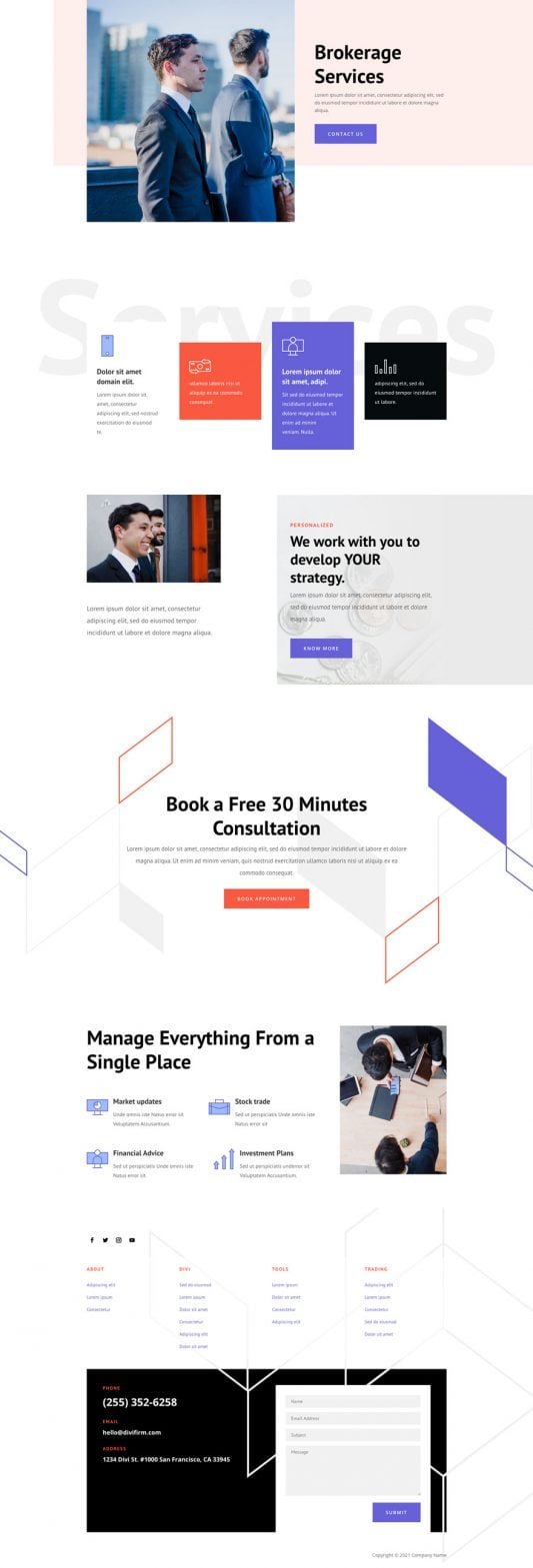
Brokerage Firm Website Demo
How Do I Analyze the Cost Per Lead (CPL) for Different Investor Segments?
We’ll enrich your social media with insightful elegance on LinkedIn and Facebook: market trend threads, webinar whispers, and success story spotlights (anonymized, naturally) that foster trust and follows. It’s your edge to emerge as the reliable guide in circles from Hobart’s heritage holdings to Darwin’s development deals.
Seeking swift client conversions? Our Google Ads and Facebook Ads are market-matched, zeroing in on Aussie wealth seekers with astute, allocation-aware campaigns that amplify appointments and minimize misses—geared for brokerage booms in Sydney and Melbourne.
We’re your steadfast strategy squad for surge, all about results that let you master the markets. Up for a relaxed review over virtual ristretto? Visit our website—let’s broker your firm’s breakout success together!